Short answer: a portable power station (a big battery with outlets) is better for short outages, apartments and anything you need to run indoors, quietly and without fuel. A generator is better for long outages and big loads such as well pumps, window air conditioners and electric cooking. Many households end up with a small power station for overnight essentials and a generator for multi-day outages.
Side-by-side comparison
| Portable power station | Gas or propane generator | |
|---|---|---|
| Typical output | 1,000–3,600 W continuous | 2,000–10,000 W running (portable) |
| How long it runs | Until the battery is empty (hours to a day or two of essentials) | As long as you have fuel |
| Where you can use it | Indoors: no fumes | Outdoors only, at least 20 feet from the house |
| Noise | Near silent | Loud enough to bother neighbours |
| Refuelling | Recharge from the wall, solar panels or a car | Stored fuel, which goes stale without stabiliser |
| Maintenance | Almost none; top up the charge every few months | Oil changes, carburettor care, test runs |
| Best for | Fridge, internet, lights, phones, CPAP, short outages | Well pumps, sump pumps, window AC, long outages |
When a power station is the better choice
- Outages usually last hours, not days. A 1,000 to 2,000 Wh unit keeps a fridge, router, lights and phones going overnight.
- You live in an apartment or have nowhere safe to run a generator. Power stations produce no carbon monoxide.
- You need power for medical equipment such as a CPAP beside the bed. Check the device's power use and choose a unit with a UPS or pass-through mode.
- You want something you will also use for camping or work.
When a generator is the better choice
- Outages regularly last more than a day and you cannot recharge a battery from solar or a car.
- You need to run motor loads such as a well pump, sump pump or furnace blower together. Their start-up surges and continuous draw quickly empty a battery.
- You want to power hard-wired circuits through a transfer switch. Standby generators can run most of a house automatically.
Work out how big a generator you need with the generator size calculator, which adds up running watts and the largest start-up surge.
How long will a power station last?
Divide the battery's watt-hours by what you plug in, then multiply by about 0.85 for inverter losses:
runtime (hours) = battery Wh × 0.85 ÷ load in watts
| Load | 1,000 Wh unit | 2,000 Wh unit | 3,600 Wh unit |
|---|---|---|---|
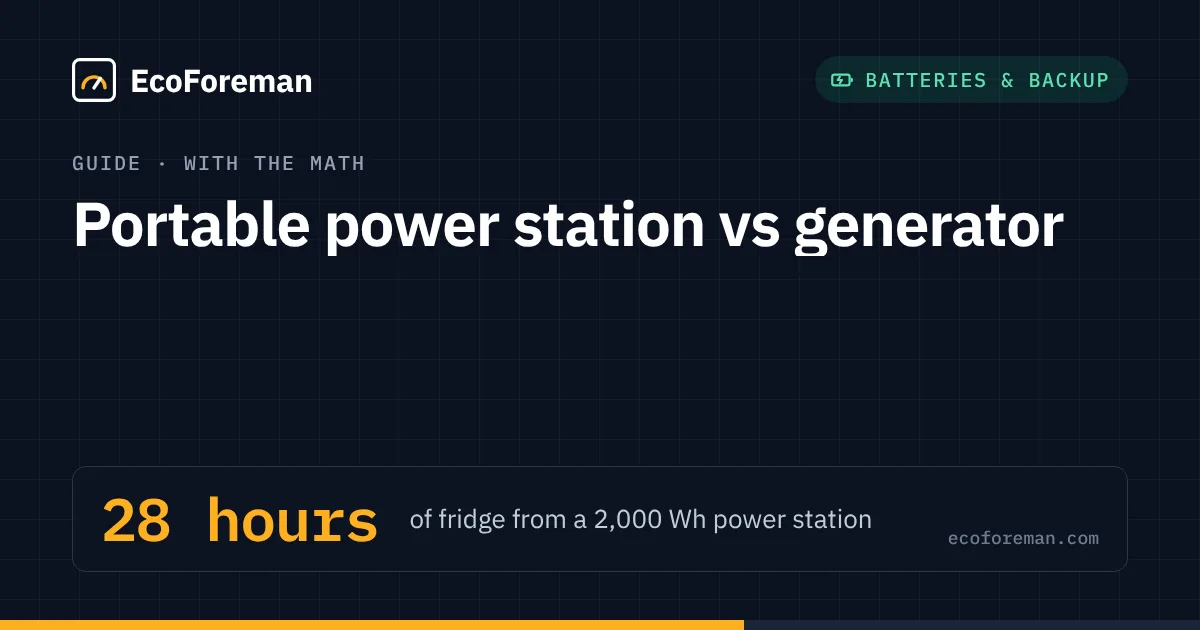
| Fridge (about 1.44 kWh a day) | about 14 hours | about 28 hours | about 2 days |
| Router + lights + phones (100 W) | about 8.5 hours | about 17 hours | about 30 hours |
| CPAP without humidifier (40 W) | about 21 hours | about 42 hours | about 76 hours |
For a fuller sizing method and four popular units compared on their specifications, see how to choose a solar generator for home backup.
Safety: the part that matters most
Generators produce carbon monoxide, which kills hundreds of people in the US every year. Run a generator only outdoors, at least 20 feet from the house, with the exhaust pointing away from doors, windows and vents. Never run one in a garage, basement, shed or porch, even with the doors open, and fit battery-powered carbon monoxide alarms inside. Never plug a generator into a wall outlet to power the house ("backfeeding"): it can electrocute utility workers. Use a transfer switch or interlock fitted by a licensed electrician.
Power stations are safe indoors, but keep them ventilated and away from heat, and do not run heaters or other high-wattage appliances from extension cords connected to them.
Cost: what you actually pay for
A generator is the cheaper way to buy a lot of power: a portable generator usually costs less than a power station of similar running watts, and fuel is cheap per kWh. A power station costs more up front per kWh of storage, but it needs no fuel, almost no maintenance and lasts thousands of charge cycles with LFP batteries. If you only face a few short outages a year, the convenience and safety are often worth more than the price difference.
Frequently asked questions
Can a portable power station replace a generator?
For short outages and essential loads, yes. For multi-day outages, well pumps or air conditioning, a single power station usually is not enough unless you can recharge it from solar.
Is a solar generator the same as a power station?
Yes: "solar generator" is a marketing name for a power station sold with solar panels.
Can I run a generator in my garage with the door open?
No. Carbon monoxide builds up quickly even with the door open. Keep it at least 20 feet from the house.
Sources
- US Centers for Disease Control and Prevention, carbon monoxide poisoning prevention.
- Power station capacities and outputs from manufacturer specifications; see our EcoFlow vs Jackery comparison for sourced examples.
Checked October 22, 2026.
Try the Generator Size Calculator
What size generator you need: running and starting watts for the appliances you want to keep on.
No comments yet.