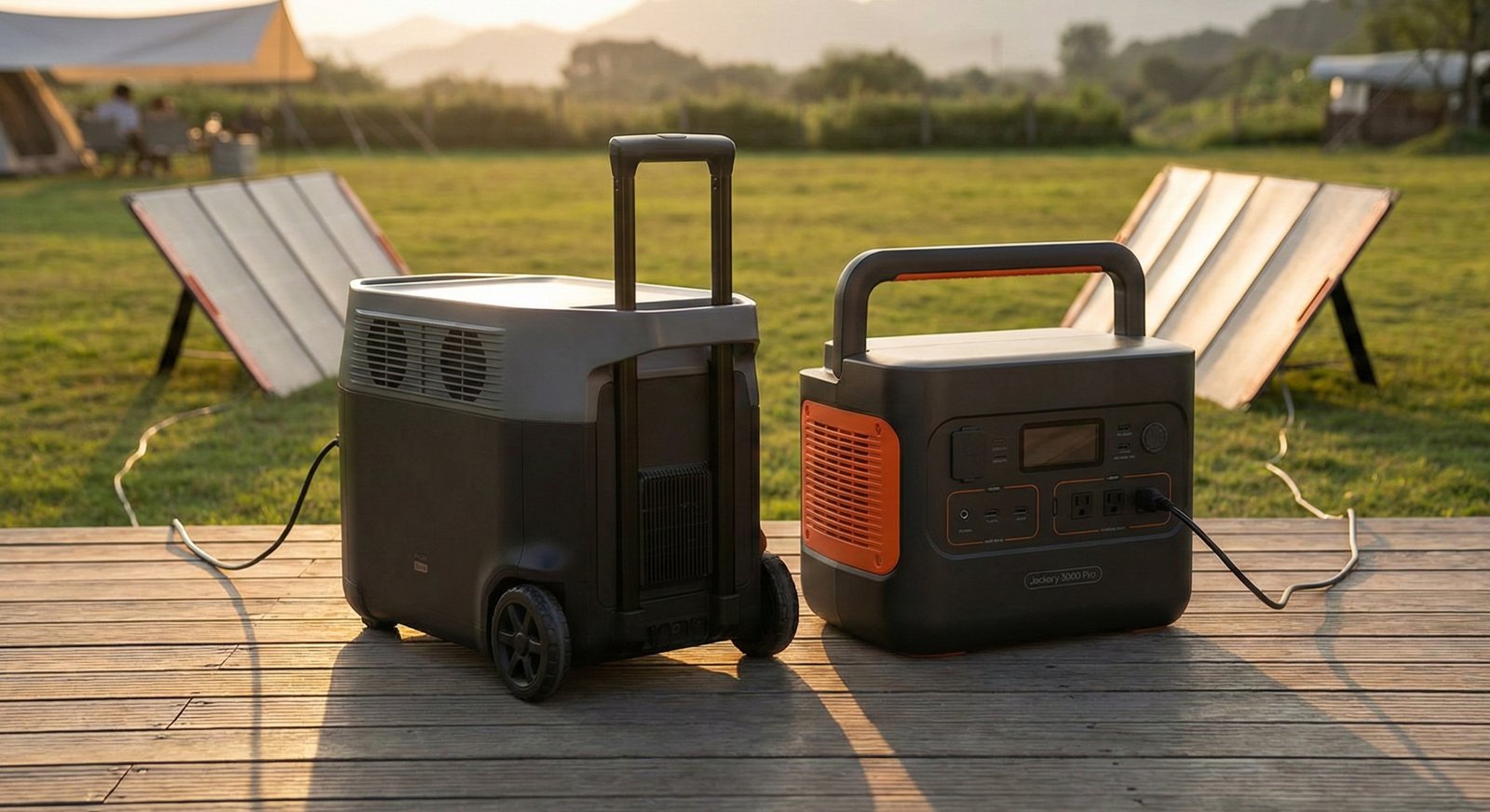
The EcoFlow DELTA Pro and the Jackery Explorer 3000 Pro are two of the largest single-box portable power stations, both aimed at home backup and RV use rather than weekend camping. This comparison is based on the manufacturers' published specifications and retailer spec sheets, checked in October 2026. We have not lab-tested these units; where listings disagree, we say so.
Quick verdict: the DELTA Pro has more capacity, a longer-life battery and can be expanded, but it weighs about 99 lb. The Explorer 3000 Pro is roughly 35 lb lighter and easier to move, but it cannot be expanded and uses a battery chemistry rated for fewer charge cycles.
Specifications side by side
| Specification | EcoFlow DELTA Pro | Jackery Explorer 3000 Pro |
|---|---|---|
| Battery capacity | 3,600 Wh | 3,024 Wh |
| Battery chemistry | LFP (lithium iron phosphate) | NMC lithium-ion |
| Rated cycle life | 3,500 cycles to 80% capacity | 2,000 to 4,000 cycles to 70%, depending on the listing |
| Continuous AC output | 3,600 W | 3,000 W |
| Surge (peak) output | 7,200 W | 6,000 W |
| Maximum solar input | 1,600 W | 1,200 W (six 200 W panels) |
| Expandable | Yes, up to two Smart Extra Batteries (10.8 kWh total) | No |
| Weight | about 99 lb (45 kg) | about 64 lb (29 kg) |
Both brands have released newer models since these launched (for example the EcoFlow DELTA Pro 3 and Jackery's v2 range). If you are buying new, compare those too: the numbers to check are the same ones in this table.
How long will each one run your essentials?
Runtime is usable capacity divided by your load. Inverters lose some energy turning battery power into household AC, so a planning figure of about 85% of the rated capacity is sensible.
| Load | DELTA Pro (about 3,060 Wh usable) | Explorer 3000 Pro (about 2,570 Wh usable) |
|---|---|---|
| Fridge only (about 1.5 kWh a day) | about 2 days | about 1.7 days |
| Fridge, router, LED lights, phones (about 2.2 kWh a day) | about 1.4 days | about 1.2 days |
| Continuous 300 W load | about 10 hours | about 8.5 hours |
| Continuous 1,000 W load | about 3 hours | about 2.6 hours |
A fridge's daily use is on its yellow EnergyGuide label (annual kWh ÷ 365). Solar charging during the day extends these times.
Where the DELTA Pro is stronger
- Battery life: LFP cells are rated for far more charge cycles than NMC and are more thermally stable. If you will cycle the unit often (daily solar use, frequent outages), this matters most.
- Growth: you can add extra batteries later, and EcoFlow sells a Smart Home Panel that connects it to selected household circuits.
- Heavy loads: 3,600 W continuous and 7,200 W surge give more headroom for well pumps, sump pumps and microwaves.
- Solar: a higher solar input ceiling means faster recharging if you have enough panels and sun.
Where the Explorer 3000 Pro is stronger
- Weight: about 64 lb versus 99 lb. If you will carry it to a vehicle, up stairs or out to a campsite, this is the biggest practical difference.
- Price: it usually costs less, and renewed units are common. Buy renewed only from a seller with a clear warranty, and test solar and AC charging inside the return window.
- Simplicity: one box, no expansion decisions.
Which should you choose?
- Choose the DELTA Pro if it will stay in one place for home backup, you want the longest battery life, or you might expand to a larger system later.
- Choose the Explorer 3000 Pro if you will move it often, mainly need a few days of essentials, and do not need expansion.
- Consider something smaller if you only need the fridge, internet and lights for a day: a 1,000 to 2,000 Wh unit costs far less. Our solar generator buying guide explains how to size one.
Frequently asked questions
Can either unit power a whole house?
No. Both can run essential loads: fridge, freezer, lights, internet, phones, a CPAP and occasional small appliances. Central air conditioning, electric heating, ovens and dryers will drain them in hours or exceed their output.
Can they run a well pump or sump pump?
Often, yes. Residential pumps typically run at 750 to 1,500 W and can draw two to three times that for a moment at start-up. Both units' surge ratings cover most pumps, but check your pump's label; a 240 V well pump needs a unit and connection that supply 240 V.
Can I connect one to my home's wiring?
Only through a transfer switch or the manufacturer's home panel, installed by a licensed electrician. Never plug a power station into a wall outlet to "backfeed" the house: it can endanger utility workers and damage equipment.
What is the difference between LFP and NMC batteries?
LFP (lithium iron phosphate) is heavier for the same capacity but lasts more charge cycles and is less prone to overheating. NMC is lighter and more compact but is usually rated for fewer cycles. For occasional backup, either is fine; for daily use, LFP lasts longer.
Sources
- EcoFlow DELTA Pro specifications from retailer spec sheets (Adorama, UK specification PDF). Checked October 21, 2026.
- Jackery Explorer 3000 Pro specifications from Jackery, Shop Solar Kits and Lowe's; cycle-life figures differ between these listings.
Specifications can change between production runs and regions. Confirm current figures on the manufacturer's site before you buy.
No comments yet.