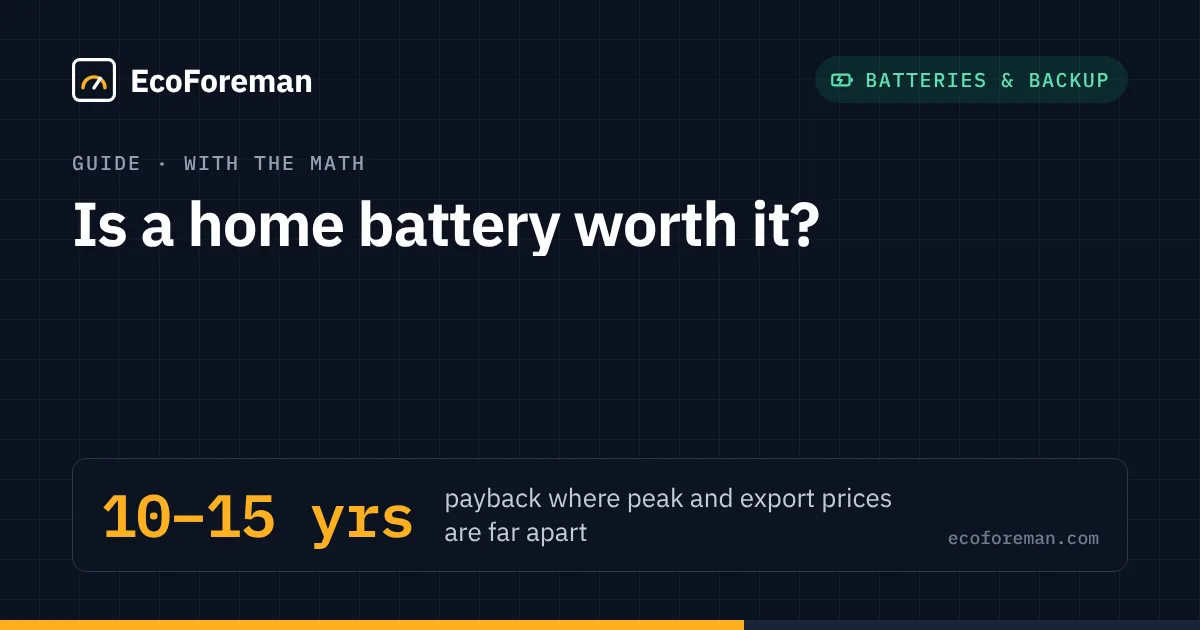
Short answer: a home battery is worth it when you get paid little for the solar power you export, when your tariff has a big gap between peak and off-peak prices, or when backup during outages matters to you. It is rarely worth it on savings alone where you have flat electricity prices and good net metering: a $13,000 battery saving $270 a year never pays for itself within its warranty. Where the conditions are right, payback of 10 to 15 years is common, which is close to the length of most battery warranties.
To size a battery for your home, use the home battery size calculator, then test your own tariff in the solar battery payback calculator.
How a battery saves money
- Storing solar instead of exporting it. Each kWh you store and use in the evening saves your retail price instead of earning a low export credit.
- Time-of-use shifting (arbitrage). Charge when electricity is cheap (overnight, or from solar) and use it at peak times. This works even without solar panels.
- Grid services. Some utilities and retailers pay you to let them draw on your battery at peak times (virtual power plants).
- Backup. No cash saving, but keeping the fridge, sump pump, heating fan and internet running during outages has real value.
The payback formula
yearly saving = kWh delivered × price you avoid − kWh stored × what you would have earned (or paid) for it
payback years = installed cost after incentives ÷ yearly saving
Batteries lose about 10% of what goes in, so a battery that stores 10 kWh delivers about 9.
Worked examples
| Situation | Working | Saving a year | Payback |
|---|---|---|---|
| US, flat 18.2¢ price, 5¢ export credit, storing 2,400 kWh of solar a year | 2,160 kWh × $0.182 − 2,400 × $0.05 | about $273 | about 48 years on a $13,000 battery: not worth it for savings |
| US, 40¢ evening peak price, 5¢ export credit (similar to newer net billing plans) | 2,160 × $0.40 − 2,400 × $0.05 | about $744 | about 17 years on $13,000 |
| UK, no solar: charge 10 kWh nightly at 7p, use 9 kWh instead of paying 26.32p | (9 × £0.2632 − 10 × £0.07) × 365 | about £609 | about 11.5 years on a £7,000 battery |
| Australia, 32¢ retail, 5¢ feed-in, storing 3,300 kWh of solar a year | 2,970 × $0.32 − 3,300 × $0.05 | about $785 | about 12.7 years if the battery costs $10,000 after the federal discount |
These are examples, not quotes: replace the prices with your own tariff and installer quote.
When a battery is worth it
- Your export credit is low compared with what you pay for electricity, as on California's net billing tariff and most UK and Australian export tariffs.
- You are on a time-of-use or EV tariff with a cheap overnight rate and expensive evenings.
- You have frequent or long power cuts, or someone in the home relies on medical equipment.
- Incentives cut the price: Australia's Cheaper Home Batteries Program, UK 0% VAT on batteries (until March 31, 2027), or state and utility rebates and virtual power plant payments in the US.
When it usually is not
- You get full retail net metering: the grid already acts as a free battery.
- You have flat-rate electricity and rare outages.
- Your solar system is small and you use most of its output during the day anyway.
- The payback is longer than the warranty (10 to 15 years for most home batteries).
Incentives in 2026
- United States: the 30% residential clean energy credit (25D), which covered batteries, ended for systems placed in service after December 31, 2025. Leases and power purchase agreements may still pass on a commercial credit. Check state programmes and utility battery or virtual power plant schemes.
- United Kingdom: batteries installed in homes qualify for 0% VAT until March 31, 2027, and several suppliers offer tariffs and export payments designed for batteries.
- Australia: the federal Cheaper Home Batteries Program gives an upfront discount through small-scale technology certificates. The discount per kWh steps down twice a year, and larger batteries get a smaller discount on capacity above 14 kWh, so check the current figure with your installer.
Frequently asked questions
How long does a home battery last?
Most come with a 10 to 15 year warranty that guarantees a share of capacity (often 70%) at the end. Lithium iron phosphate batteries usually outlast their warranty if not cycled hard.
Is a battery worth it without solar?
Sometimes, on a tariff with cheap overnight power and expensive peaks, as in the UK example above. Without such a tariff, a battery without solar only provides backup.
Is a battery better than a generator for backup?
A battery is silent, switches over automatically and needs no fuel, but runs out within a day or two without solar. A generator runs as long as you have fuel. See power station vs generator and how long a 10 kWh battery lasts.
Sources
- IRS, FAQs on the 2025 changes to section 25D.
- Clean Energy Regulator, Cheaper Home Batteries Program.
- HM Revenue & Customs, VAT on energy-saving materials.
- Electricity prices: EIA 2026 forecast (US), Ofgem cap October–December 2026 (UK), 2026 retailer data (Australia).
Checked October 22, 2026. Battery prices vary widely; get at least two quotes.
Try the Home Battery Size Calculator
How many kWh of battery backup you need for an outage, and how much power it must deliver at once.
No comments yet.