- Admin
- Mar 11th, 2026
Best Solar Phone Charger for Camping: Reliable, High-Capacity Options for the Outdoors
There's nothing worse than being three miles into a trail and watching your phone battery hit 10% — especially when it's your map, your camera, and your emergency contact all at once. Solar phone chargers solve that problem without the weight and bulk of a full power station. Whether you want a slim foldable panel that clips to your pack and charges as you hike, or a rugged power bank with built-in solar for campsite top-ups, there's a genuinely useful option for every type of camper.
The challenge is knowing what you're actually buying. Solar charging on small portable units is almost always slower than the marketing suggests — panels are small, output varies wildly with sun angle and cloud cover, and most units work best when you treat the solar panel as a supplement rather than the primary charger. We tested a range of compact foldable panels and solar power banks against real camping conditions to find the ones that actually deliver when it counts. Here's what we found.
Best Solar Phone Chargers for Camping — Quick Comparison
| Product | Type | Capacity / Output | Best For |
|---|---|---|---|
| BLAVOR Solar Power Bank 10,000mAh | Power Bank + Solar | 10,000mAh / 20W USB-C | Weekend trips, portable backup |
| Kepswin 49800mAh Solar Charger | High-Cap Power Bank + Solar | 49,800mAh / Built-in cables | Multi-day basecamp & group charging |
| BigBlue 28W Solar Charger | Foldable Solar Panel | 28W / No built-in battery | Backpackers, direct solar charging |
| BLAVOR 10,000mAh Solar Power Bank | Power Bank + Solar | 10,000mAh / 20W USB-C | Trail backup, rugged everyday carry |
| SOXONO Solar Power Bank 40,000mAh | High-Cap Power Bank + Solar | 40,000mAh / 20W PD + Built-in cables | Car camping, extended off-grid trips |
Best Solar Phone Chargers for Camping — Full Reviews
We tested each of these in real camping conditions — varying sun, moving packs, wet weather — to cut through the spec sheet claims. Here's the honest breakdown.
BLAVOR Solar Power Bank 10,000mAh

If you want something compact enough to clip onto your pack, fast enough to actually charge your phone on the trail, and rugged enough to take a few knocks — this is the one we'd reach for on a weekend trip.
Pros
- 20W USB-C output genuinely gets phones to usable levels fast, not just a trickle
- Compact, solid-feeling build with dual flashlights and a carabiner slot that actually works
- Wireless charging is a surprisingly handy bonus at the picnic table
Cons
- Solar trickle is real — don't expect meaningful recharge from the panel alone
- USB ports have a history of weakening over heavy repeated use
- Splash resistant, not waterproof — keep it sheltered in heavy rain
We clipped this onto our pack and ran it through a few weekend trips, specifically to see how it held up on the move. The USB-C 20W output was the real standout — phones went from near-dead to usable in under an hour, which made a genuine difference when we were still setting up camp and needed navigation running.
The form factor is genuinely pocket-friendly for something with this many features. The flashlights came in handy more than expected — twice for late-night tent runs, once when someone needed to read a trail map after dark. Wireless charging worked cleanly when we wanted to skip cables at the campsite table.
Solar charging was as slow as we expected — on a full sunny afternoon we got a partial top-up, not a full recharge. We treated it as a nice emergency feature rather than the primary strategy. Before any trip we charged from the wall, and that made the whole experience much less stressful.
→ See BLAVOR Solar Power Bank 10,000mAh on Amazon
Kepswin 49800mAh Solar Charger
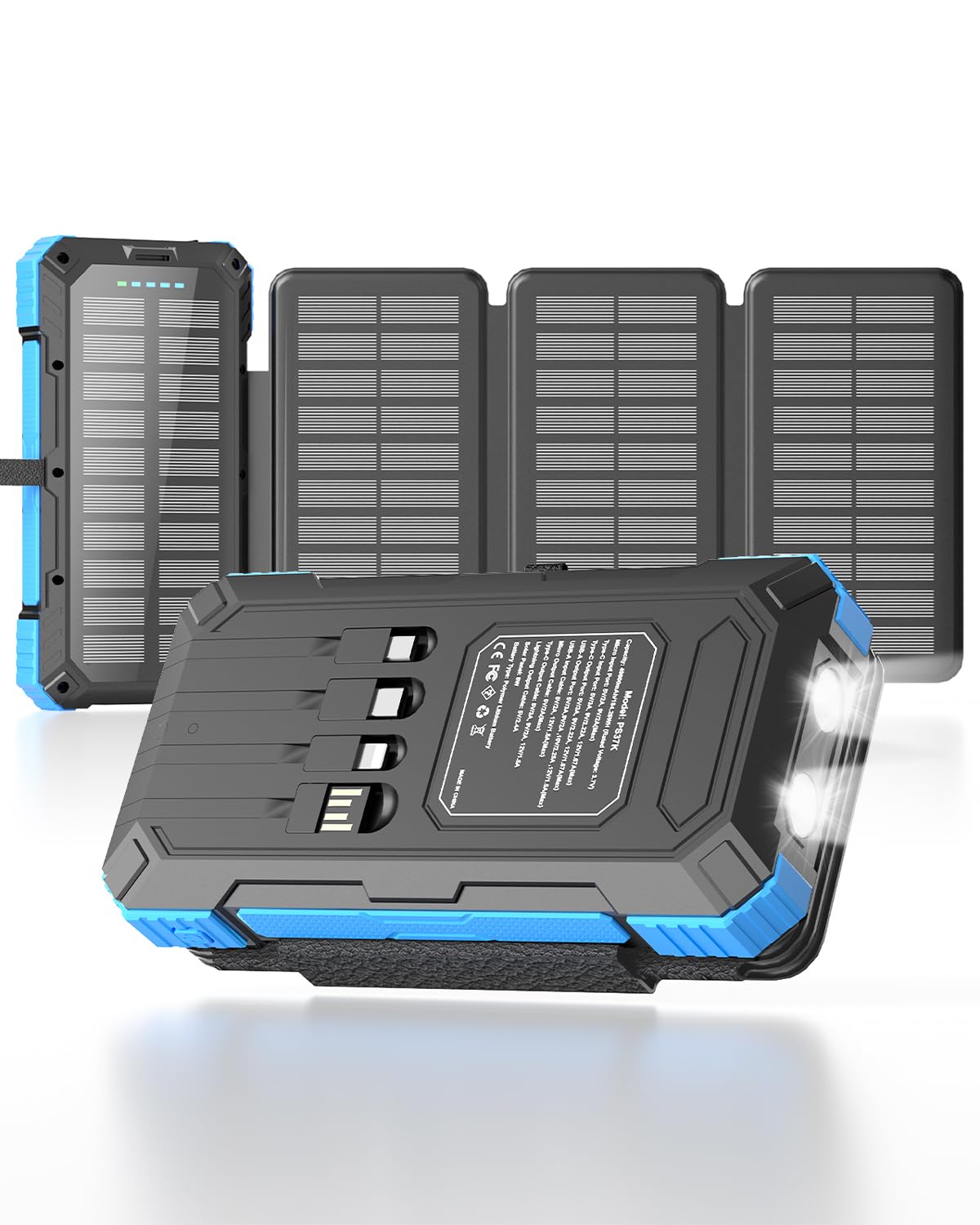
This one's for the group camper or anyone setting up a basecamp situation where multiple people need power for multiple days. It's not a hiking companion — it's a charging hub that happens to have solar panels on it.
Pros
- Built-in Lightning, USB-C, Micro USB, and USB-A cables mean nobody's scrambling for the right cord
- Huge capacity — we cycled phones many times over three days without breaking a sweat
- Rugged build with solid SOS flashlight modes that actually feel useful in the field
Cons
- Solar recharge is slow and inconsistent — it's a supplement, not a solution
- Built-in cables are a bit short when you want to use your phone while it's plugged in
- High capacity almost certainly exceeds airline carry-on battery limits — check before flying
We took this on a three-day trip as the shared charger for four people — phones, a tablet, earbuds, and a Bluetooth speaker all came through it at various points. The built-in multi-cable setup was a genuinely practical design choice; no more digging through bags for the right connector at 6am before a hike.
Battery held up through heavy use without issue. The shell handled rain and drops on rocky terrain without drama, and the carabiner made attaching it to the outside of a pack easy on day hikes. The SOS strobe on the flashlight is the kind of feature you hope you never need and feel better for having.
Solar charging through the foldable panels performed better than single-panel banks, but a full solar recharge still took a very long time. Our strategy: charge it fully before leaving home, use solar to slow the drain on long sunny days, top up from the car on the way home. That worked well.
→ See Kepswin 49800mAh Solar Charger on Amazon
BigBlue 28W Solar Charger

This is the panel you want if you're serious about solar charging on the trail rather than treating it as an emergency backup. No built-in battery means no extra weight — just high-efficiency panels that do the job while you're moving or setting up camp.
Pros
- Genuinely impressive output for the weight — folds small but delivers real wattage in good sun
- Dual USB-C plus USB-A lets you charge phone and power bank simultaneously
- Tougher than it looks — survived drops, branches, and light rain across our test hikes
Cons
- No built-in battery — if the sun goes behind clouds, charging stops
- Output varies noticeably with angle and light; you have to be strategic about placement
- The USB junction box needs protection in heavy rain — it's not fully waterproof
We carried this clipped to the back of a pack over a three-day route and it earned its place. Unfolding it at a rest stop, propping it against a rock, and watching the LED light up was satisfying. We charged a phone and a power bank simultaneously while cooking lunch — both were meaningfully topped up by the time we packed up.
Midday in direct sun was clearly the sweet spot — we got close to rated output. Morning and late afternoon sun, or partial cloud cover, cut the rate noticeably but didn't stop it entirely. Positioning matters: spending 30 seconds finding the right angle makes a meaningful difference in output.
The panel felt more durable than a lot of folding panels we've tried. It took a couple of drops and some brush contact without any surface damage. Just shelter the junction box if heavy rain hits — that's the one place it's more vulnerable.
If you're a backpacker who wants to actually use solar as a charging strategy and not just a backup, pair this with a small power bank and you have a genuinely capable lightweight system.
→ See BigBlue 28W Solar Charger on Amazon
BLAVOR 10,000mAh Solar Power Bank
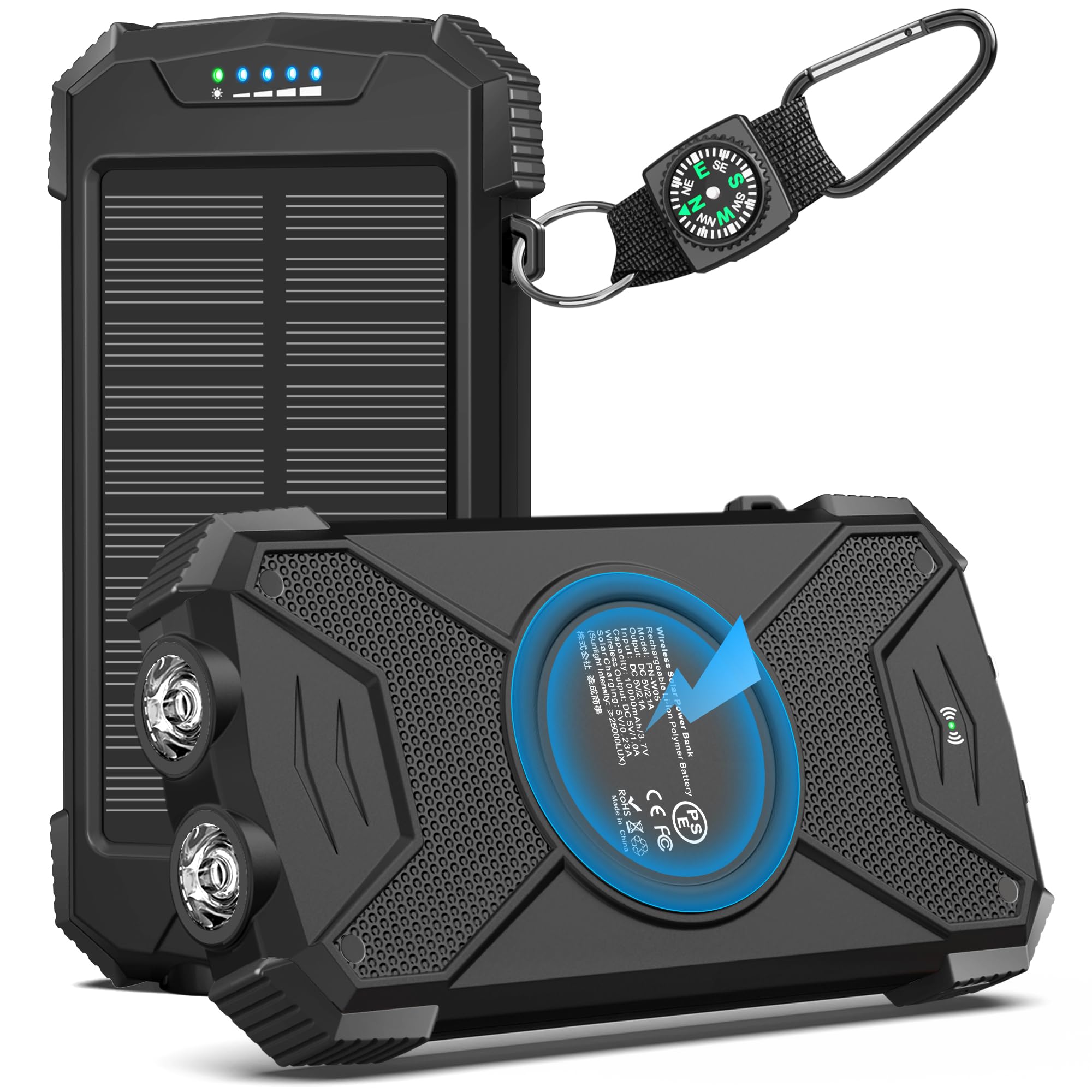
A solid trail companion if your priority is fast wired charging and rugged durability, with solar available as a genuine emergency option. Think of it as a quality power bank that also happens to have solar — not the other way around.
Pros
- 20W USB-C charging revives phones quickly — noticeably faster than entry-level banks
- Rubberized shell feels genuinely shock and water resistant, not just marketed that way
- Dual flashlights and carabiner clip are small features that earn their keep on the trail
Cons
- Solar panel charges very, very slowly — emergency use only
- Some long-term users have reported USB port failures — handle connections gently
- 10,000mAh is modest if you're going more than 2–3 days between wall charges
We clipped this to our pack and used it across a weekend of trails. The rubber shell shrugged off grime and the flashlight came in genuinely handy twice — once while breaking down camp after dark, once for a small emergency on a night hike. The carabiner slot is a better design than the strap systems on cheaper units.
Charging speed impressed us. An iPhone from near-empty to functional took around 45 minutes with the 20W USB-C — a meaningful improvement over the 5–10W banks we've been carrying for years. Running two devices simultaneously didn't slow things down noticeably.
Solar performance was honest: slow, dependent on direct sun angle, useful for emergencies or extended daylight exposure but not quick recharges. A few hours direct sun gave us a partial top-up — enough to extend the trip by half a day if we were careful. That's genuinely useful as a backstop, just not as a plan.
→ See BLAVOR 10,000mAh Solar Power Bank on Amazon
SOXONO Solar Power Bank 40,000mAh
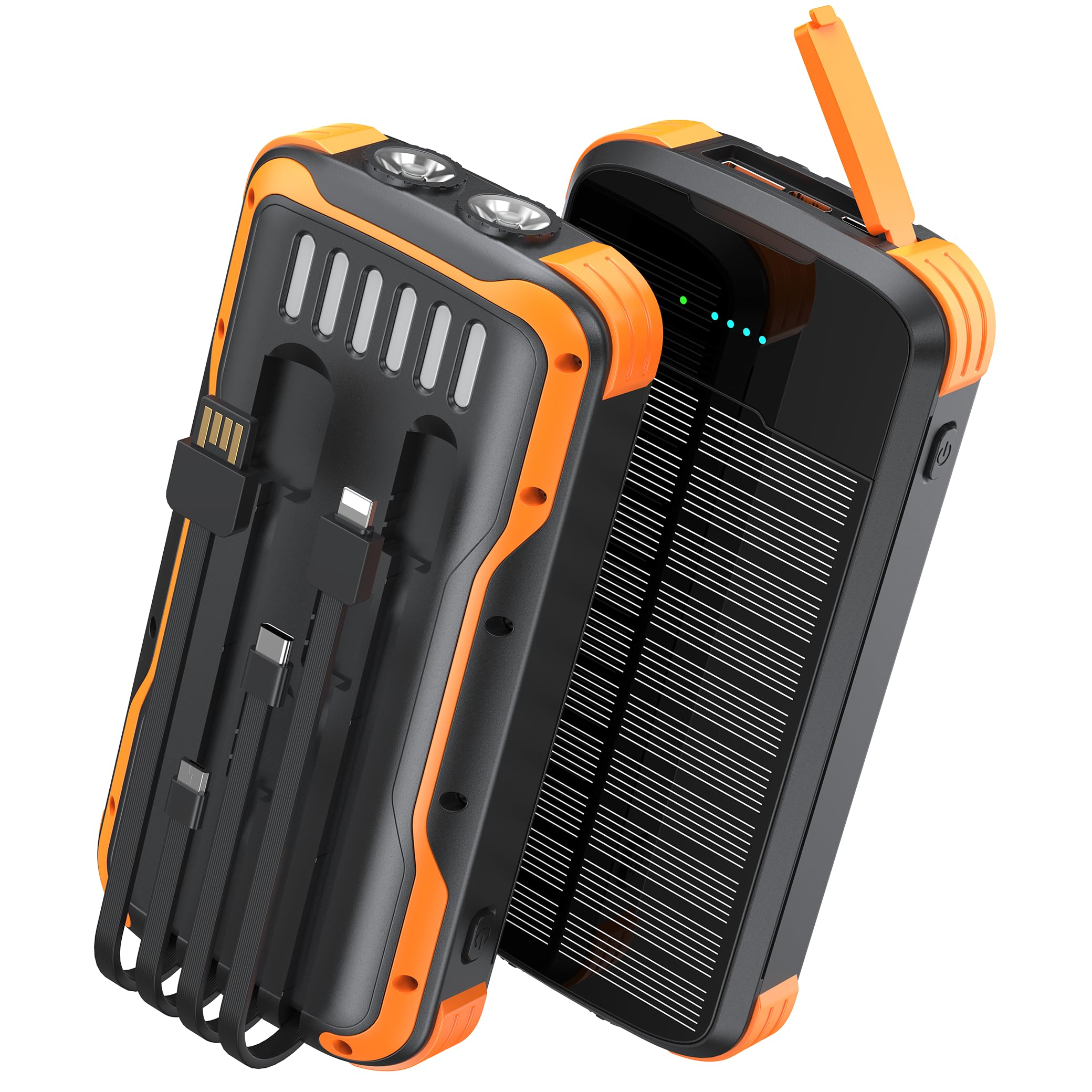
If you're car camping or setting up a base where power runs out over days rather than hours, this is a genuinely capable charging solution. Heavy, but built for it.
Pros
- 40,000mAh capacity kept our whole group going for four days without a wall charge
- Built-in cables and 20W PD fast charging meant fewer cords and faster top-ups
- Waterproof and dust-proof ABS shell survived a genuinely rainy night without issue
Cons
- Heavy — we felt it on longer hikes and eventually left it at the campsite
- Solar panel charges slowly — useful for topping up over long sunny days, not for quick recharges
- Built-in cable functionality can be confusing in the field (input vs. output switching)
We pulled this out of the box on the first evening and immediately liked how solid it felt. The ABS casing survived drops on rocky ground and a full rainy night without any signs of moisture inside. The two flashlights lit up our cooking area effectively and the SOS strobe felt like real emergency kit, not an afterthought.
Over four days of car camping with four people — phones, earbuds, a portable speaker, a tablet — this kept everyone charged without us ever worrying about it. The built-in cables genuinely reduced cord chaos; we grabbed one device and had the right connector already attached. The 20W USB-C got phones back to usable levels quickly when emergencies (or early-morning navigation needs) came up.
Solar throughput was modest — we left it angled toward the sun during long afternoon rests and recovered maybe 10–15% per day on a good day. Enough to slow the drain, not to restore the full battery. For our use case — top up at home, use solar to extend the life, recharge from the car on the way back — it worked perfectly. For ultralight hikers relying on solar alone, it's the wrong tool.
→ See SOXONO Solar Power Bank 40,000mAh on Amazon
Buying Guide: How to Choose the Right Solar Charger for Camping
The single most important thing to understand before you buy: solar panels on portable chargers are small, and small panels charge slowly. Every unit on this list has some solar capability, but all of them work best when you pre-charge from a wall outlet before your trip and treat the solar input as a supplement or emergency top-up. That expectation shift makes these products genuinely useful instead of frustrating.
Know what type you actually need. There are two main categories: foldable solar panels (like the BigBlue 28W) that have no built-in battery and require direct sunlight to charge connected devices, and solar power banks (like the BLAVOR and SOXONO units) that store energy internally and charge devices any time. For backpackers who move constantly and see a lot of sun, a panel + small power bank is the lightest setup. For car campers or groups, a high-capacity power bank wins.
Match capacity to trip length. A 10,000mAh bank gives roughly 2–3 full phone charges. A 40,000mAh unit gives 10–12. For a solo weekend trip with one phone, 10K is plenty. For multi-day trips or group use, go bigger. And remember: solar won't fully restore large banks during a typical camping day — it just extends how long they last.
Check the output wattage on the USB ports. 5W (standard USB-A) takes forever. 18–20W (USB-C PD) charges a phone 3–4x faster. If fast charging matters to you, verify the unit actually supports 18W+ output, not just input. Several units market "fast charging" but only achieve it on one specific port.
Weather resistance matters more than you think. IP65 or better is what you want if the device will spend time in a pack exposed to rain. "Splash resistant" is the bare minimum. If you're kayaking, river camping, or in a genuinely wet environment, look for higher ratings and check the junction box/port covers specifically.
Weight is a real trade-off. A 40,000mAh power bank weighs close to 2 lbs. That's a meaningful addition to a backpack. If you're counting ounces, a lightweight foldable panel paired with a small 10K bank is the smarter system. If you're car camping and weight doesn't matter, go for capacity.
Built-in cables are a genuine convenience feature. If you're sharing a charger with a group, having Lightning + USB-C + Micro USB built in saves real frustration. If you're going solo and already have the right cables, they're less critical.
Airline rules matter for pre-trip planning. Banks over 100Wh (roughly 27,000mAh at 3.7V) typically require airline approval, and some over 160Wh are not allowed in carry-on at all. If you're flying to your campsite, check the specific battery capacity and your airline's policy before packing.
Frequently Asked Questions About Solar Phone Chargers for Camping
Can a solar phone charger actually charge my phone while hiking?
Yes — if you're using a foldable solar panel (like the BigBlue 28W) attached to the back of your pack facing the sun. You'll get slower-than-home charging speeds, and output drops when you move through shade or clouds, but it works. Solar power banks also work while hiking if they have enough stored charge — the solar panel just helps slow the drain. Direct charging from a panel to a phone requires decent sunlight and the right panel angle.
How long does it take to charge a phone with a solar charger while camping?
With a quality foldable panel (28W+) in direct midday sun and a modern phone that supports fast charging, you can get a near-full charge in 1.5–2.5 hours. Solar power banks with small built-in panels (5–10W) take 2–4 hours in ideal conditions just to charge a single phone. Cloud cover, shade, or suboptimal panel angle can double or triple those times. For consistent performance, pre-charge your power bank before you leave.
What's the difference between a solar panel and a solar power bank for camping?
A solar panel (like the BigBlue) converts sunlight directly to electricity — it has no built-in storage. Devices attached to it charge when the sun is out and stop when it goes in. A solar power bank (like the BLAVOR or SOXONO) has an internal battery plus a small solar panel — it charges internally from sun and lets you charge devices any time, even at night. For most campers, a solar power bank is more practical. For serious backpackers focused on weight, a standalone panel paired with a small power bank gives more flexibility.
Are solar chargers waterproof enough for camping?
Most quality camping solar chargers are splash-proof or water-resistant (IP65 or similar), which handles rain and campsite moisture well. None of the units on this list are designed for full submersion. The most vulnerable spots are the USB port covers and junction boxes — keep those covered and sheltered in heavy downpours. For kayaking or very wet environments, look for units with higher IP ratings and sealed ports.
How many mAh do I need in a solar power bank for camping?
As a rough guide: 10,000mAh gives 2–3 full phone charges; 20,000mAh gives 4–6; 40,000mAh gives 10–12. For a solo weekend trip with one phone, 10,000mAh is usually enough if you're conservative. For multi-day trips, group use, or charging tablets and cameras too, 20,000–40,000mAh is more appropriate. Factor in that solar won't fully restore large banks on a typical camping day — treat solar input as a top-up bonus, not the primary recharge strategy.
Can I take a high-capacity solar power bank on a plane?
It depends on the battery capacity. The FAA (and most international equivalents) allows lithium batteries up to 100Wh in carry-on without special approval. That's roughly 27,000mAh at 3.7V. Banks from 100–160Wh require airline approval, and anything over 160Wh is generally not permitted in the cabin. A 40,000mAh bank at 3.7V is around 148Wh — close to the limit, so always verify with your airline before travel. Power banks are never allowed in checked baggage.
Do solar chargers work on cloudy days while camping?
Yes, but at significantly reduced output — typically 10–25% of rated capacity depending on cloud density. Solar panels still generate some electricity from diffuse light, but you shouldn't count on meaningful charging during overcast periods. This is another reason to pre-charge your power bank fully before the trip and treat solar as a supplement rather than the primary source.
What should I look for in a solar charger for backpacking specifically?
For backpacking, weight and packability are the top priorities. Look for: a foldable panel with attachment points (D-rings or carabiner loops) to clip to your pack, a lightweight small power bank (10,000mAh or less) for overnight storage, USB-C PD output for fast charging during rest stops, and an IPX4+ weather resistance rating. The BigBlue 28W + a slim 10K power bank is a setup we'd recommend for most backpackers who are serious about staying charged without weighing down their kit.
How is a solar phone charger different from a full solar generator?
Solar generators (like the EcoFlow DELTA 2 or Jackery Explorer 1000 v2) are much larger systems — multiple kilowatt-hours of storage, AC outlets, and the ability to run appliances like refrigerators and laptops for days. Solar phone chargers are pocket-scale devices for keeping handheld electronics running. If you need to power more than phones and small devices during camping or a power outage, see our full guide to the best solar generators for home backup.